


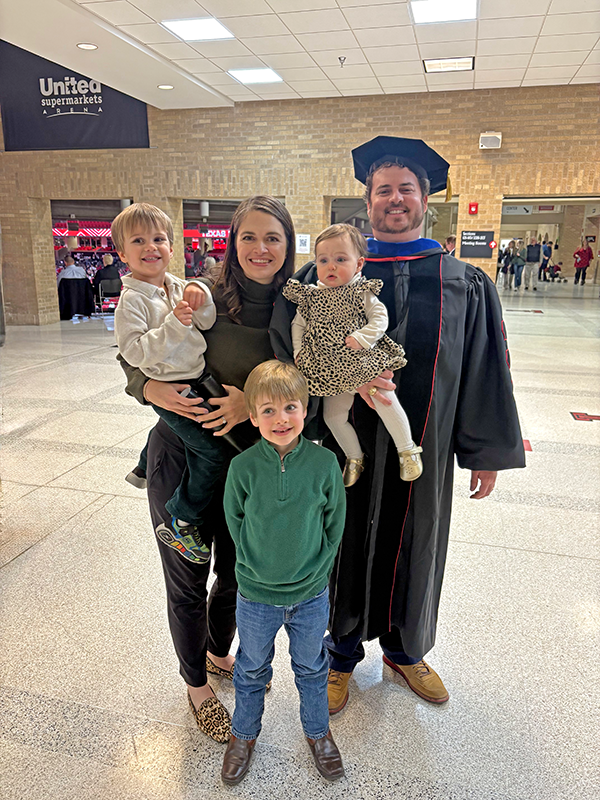
Last fall, Daniel Forman officially became Dr. Forman after successfully defending his doctoral dissertation. Following the defense, the manuscript went through the university’s required post-defense review process, including multiple stages of editing and formatting. By early December, all revisions were approved and the dissertation was finalized.
Because his research reflects the experiences of students in an independent-school setting, and draws directly from the unique culture of TMI, Dr. Forman felt it was important to share the completed manuscript with the TMI community. The study tells a story about our school, our students, and the environment that shapes their growth.
“TMI has supported me tremendously throughout this five-year journey, and I hope that research centered on independent schools continues to grow, especially given how special and distinctive our communities are,” Dr. Forman shared.
Research Focused on the Whole Student
Dr. Forman’s dissertation examined the impact of extracurricular activities (ECAs) on academic outcomes and student well-being within the context of an independent Episcopal school. While much existing research focuses on public schools, independent schools are rarely studied in this way, making this work especially relevant for schools like TMI.
The study explored how participation in athletics, arts, academic clubs, service, and other programs relates to:
- Academic performance (GPA, PSAT, and SAT)
- Students’ perceived stress levels
- Students’ sense of belonging, growth, and balance
Key Findings
The research found that the number of activities students participated in, or the total hours spent in extracurriculars, did not significantly predict GPA or standardized test scores. In a high-achieving academic environment like TMI, academic outcomes were more closely related to students’ grade level and overall academic support.
What stood out most were the developmental and community benefits students consistently described:
- Stronger time-management and academic routines
- Growth in leadership, confidence, and practical skills
- A strong sense of belonging through teams, ensembles, clubs, and mentors
Students also shared that busy seasons could bring added pressure, reinforcing the importance of balanced, purposeful involvement and attentive guidance from adults.
Adds Evidence from an Independent-School Context
Dr. Forman’s research highlights that in independent schools — where academics are already highly supported — ECAs may show little direct impact on GPA or test scores. Yet the benefits for students’ personal and social development are clear. These experiences help students grow as leaders, collaborators, and members of their communities.
The practical takeaway is to aim for balanced, purpose-driven participation and carefully coordinated schedules. Rather than focusing solely on measurable academic outcomes, it is important to consider the indirect ways ECAs contribute to growth over time. The ultimate lesson is that ECAs shape who students become more than what they score — when designed intentionally, they foster character, confidence, and connections that last well beyond the classroom.
Why This Matters for TMI
Dr. Forman’s research affirms what our community experiences every day: meaningful programs and strong relationships with teachers and mentors are central to student growth. While academics remain a priority, it is the combination of classroom learning, extracurricular opportunities, and dedicated faculty support that shapes confident, capable, and connected students.
We are grateful to have educators at TMI who invest deeply in students both inside and outside the classroom, and Dr. Forman’s work highlights how that commitment plays a vital role in the whole-student experience that defines TMI.